
Online Piano Student Progress: Measuring What Truly Matters

Updated: Nov 11
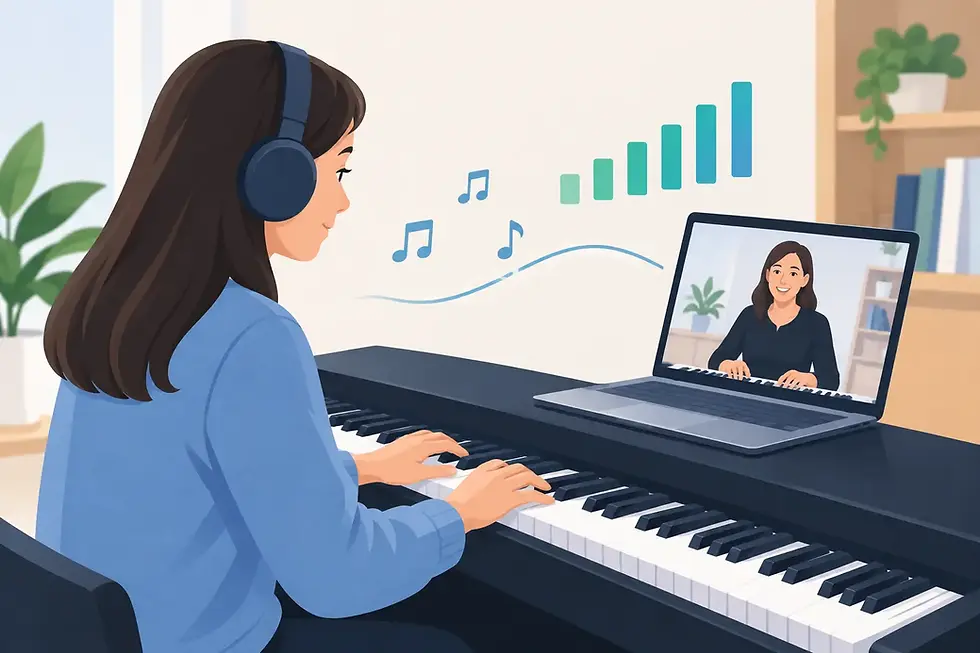
A beginner manages to hit every note in an assignment, closes the method book, and marks the page done. To a casual listener, the assignment is finished. But listen closer: the left-hand accompaniment was overpowering the melody, the wrist locked into rigid stiffness during the final four bars, and the pulse drifted every time the right thumb had to tuck under.
Turning pages in a book is not development.
Genuine online piano student progress isn't measured by how quickly someone burns through repertoire collections. It reveals itself in how a musician listens, how freely their hands move across the keys, and whether they can self-correct when an exercise wavers.
1. What Meaningful Online Piano Student Progress Looks Like
When piano instruction leans solely on song completion, students eventually hit a wall. They might memorize three recital pieces through mechanical muscle memory, but hand them a simple sight-reading exercise or ask them to play an expressive crescendo, and the playing freezes.
True progress builds transferable technical capability:
Subconscious Rhythmic Stability: The student stops guessing the beat and internalizes the subdivision. They keep a steady pulse through difficult octave jumps without accelerating the easy passages.
Dynamic Voicing Separation: The brain coordinates independent weight distribution between the hands—delivering a singing, ringing right-hand melody over a soft, supportive left-hand foundation.
Ergonomic Freedom: The wrist acts as an agile shock absorber rather than a frozen hinge, letting arm weight drop naturally into the keybed without forearm strain.
Diagnostic Self-Listening: When a mistake occurs, the student pauses, pinpoints whether the error was fingering, rhythm, or hand spacing, and isolates the fix instead of restarting blindly from measure one.
2. Why Virtual Teaching Catches What Living Rooms Miss
There is an old critique that piano cannot be taught through a screen. That critique makes sense if a lesson is treated like an ordinary, low-bandwidth video call where a teacher squints at a sideways phone camera.
A dedicated virtual piano studio flips that dynamic entirely:
Overhead Keyboard Geometry: A top-down broadcast camera shows the instructor every finger number, knuckle angle, and thumb-tuck transition simultaneously, offering a vantage point that sitting on a piano bench next to a student rarely provides.
Dynamic Sound Reproduction: Uncompressed, low-latency audio transmission preserves acoustic hammer transients, pedal resonance, and delicate pianissimo touches without the harsh noise gating that swallows musical nuance.
Direct MIDI and Screen Markup: Score annotations happen on a shared digital sheet in real time, drawing eyes to specific phrasing brackets, pedal lifts, and fingering shifts right as they occur.
Because instruction happens on the student's personal instrument, every mechanical adjustment matches the key resistance and bench height they live with all week.
3. Breaking Down the Plateau: Where Development Stalls
When a student’s advancement plateaus, the culprit is almost never a lack of natural musicality. The breakdown happens within the practice ecosystem.
THE "PLAYTHROUGH" LOOP (Zero Growth)

Start Measure 1 ──► Hit Stumble at Measure 14 ──► Restart from Beginning ──► Cement Mistake

THE TARGETED RECOVERY PROTOCOL (Rapid Breakthrough)

Isolate Measures 13-15 ──► Subdivide at 50% Tempo ──► Restore Wrist Cushion ──► Loop Cleanly 5x ──► Integrate
Most stalled progress traces back to three structural oversights:
The Run-Through Trap
The instinct of almost every student is to practice by playing a piece straight through from start to finish. If they stumble at measure twelve, they stop, grimace, and start over at measure one.
This method trains the first four measures twenty times while the actual problem area receives two chaotic repetitions. Real skill demands isolating the two-measure friction point, dropping the tempo, and looping the specific physical hand shift.
Uncalibrated Keyboards
A cheap portable keyboard with unweighted plastic keys limits a student's technical ceiling. Without weighted hammer action and touch sensitivity, the hands never learn to control arm weight, dynamic contrast, or finger articulation. Progress accelerates the moment the physical instrument offers realistic acoustic resistance.
Ambiguous Weekly Targets
Assignments like "practice page 24" invite distraction. Actionable practice targets are specific: "Keep the left-hand Alberti bass at pianissimo while shaping the right-hand phrase to a forte at bar eight." When the target has clear acoustic boundaries, the student knows precisely when the job is done.
4. Building Sustainable Performance Habits
Ten minutes of deliberate, forensic focus will outperform an unfocused hour of distracted noodling every single time.
Productive keyboard sessions rely on three distinct operational blocks:
Tactile Reset: Three to five minutes dedicated solely to physical freedom—scales, arpeggios, or technical patterns executed with loose wrists, dropped shoulders, and level breathing.
Micro-Surgical Isolation: Ten minutes zeroed in on the exact measures that felt unstable in the last session, keeping the metronome slow enough that mistakes are mechanically impossible.
Architectural Run-Throughs: Playing the full section or piece to train focus and continuity, deliberately learning to keep the musical pulse alive even if a transient finger slip occurs.
5. From Mechanical Drills to Independent Musicianship
The ultimate marker of advancement at the keyboard is not pleasing a teacher once a week; it is developing an internal compass that allows you to play with genuine authority and expressiveness.
When an instructor shows you how your wrist geometry, posture, and listening habits directly create the sound you hear, the confusion disappears. You stop wrestling with the keys and start making music with intention.
During an intro session, we bypass the generic drills—evaluating your instrument setup, assessing your physical hand mechanics across clear camera angles, and tailoring a structured weekly plan for your specific goals.
If you are ready to move past repetitive practice and experience clear, measurable progress at the keys, schedule a private intro session with Better World Music School to have your playing assessed with high-definition clarity.


Comments