
The Danger of Nostalgia: What Japan’s Economic Shift Teaches Us About the Future of Learning and Work
- Better World School of Music
- Jul 1
- 4 min read

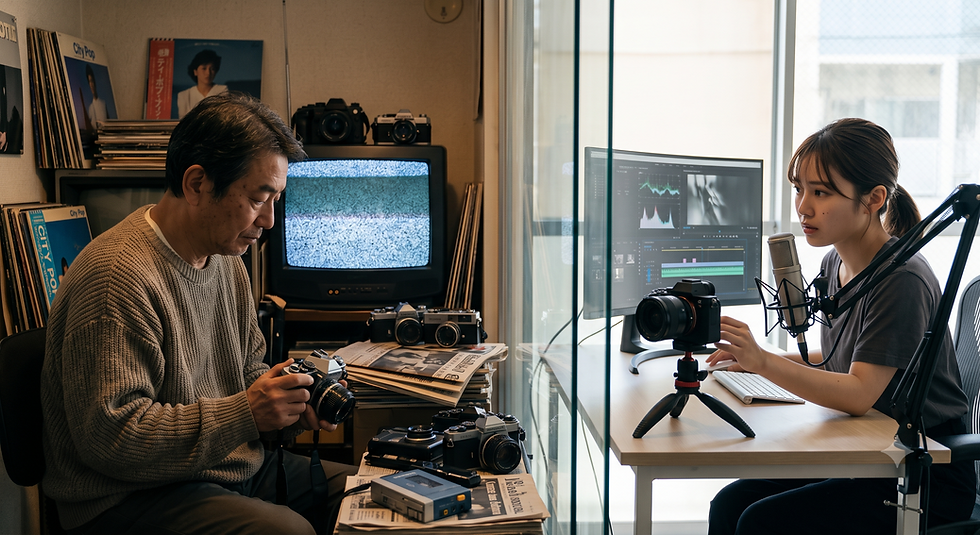
Nostalgia is a powerful emotional anchor. It sweetens our memories, romanticizes our past triumphs, and provides a sense of comfort. But when macroeconomics, entire societies, or individual development are held hostage by nostalgia, it ceases to be a comforting sentiment—it becomes a structural hazard.
To understand how romanticizing the past can stall future progress, we only need to look at the macroeconomic trajectory of Japan over the past several decades. In the 1970s and 1980s, Japan was the undisputed global titan of the hardware era.
From pioneering automotive engineering to dominating consumer electronics through iconic giants like Sony and Panasonic, Japan’s manufacturing prowess was deemed an irreversible economic miracle.
Yet, this very dominance created a dangerous institutional comfort zone. When the global landscape shifted in the late 1990s and 2000s toward software, internet infrastructure, and cloud-first ecosystems, a profound cultural and structural reluctance gripped the nation.
Rigid corporate hierarchies and an emotional attachment to legacy physical infrastructure slowed down digital transformation. By clinging to the operational frameworks that brought yesterday’s success, Japan largely missed the software wave, leading to decades of stagnant labor productivity outside of its core manufacturing sectors and eventually relinquishing its status as the world’s second-largest economy.
The lesson is stark: when an individual or an entire society confuses the "legacy artifact" of success with the fundamental mechanism of value creation, stagnation is inevitable.
The Microcosm: Romanticizing the Traditional Classroom
Today, we see this exact brand of digital nostalgia playing out in the world of education and specialized training. Traditionalists frequently insist that true mastery can only be cultivated within the physical walls of an in-person environment.
They romanticize the friction of the legacy model—the commute, the institutional room, the physical proximity—under the assumption that physical presence inherently equates to superior instruction.
This perspective mirrors the hardware-era mindset. It assumes that digital alternatives are merely a poor, compressed substitute for the "real thing." And to be fair, when remote learning is executed poorly—relying on grainy laptop webcams, unstable internal microphones, and compressed, laggy software—it is an inferior experience.
However, when remote learning is decoupled from legacy compromises and executed correctly, it transitions from a fallback option into a platform that is fundamentally superior to its in-person counterpart.
The High-Fidelity Paradigm: Unlocking Elite Instruction
True digital transformation in education occurs when we replace legacy friction with professional-grade, high-fidelity infrastructure. When an instructor and student connect using 4K high-resolution cameras, studio-quality audio interfaces, and professional reference microphones, the pedagogical dynamics shift dramatically:
Macro-Level Visual Fidelity: In a traditional room, a student and instructor sit several feet apart. Nuanced, macro-level physical adjustments—whether it is the exact placement of hands on an instrument, technical posturing, or the precise physiological adjustments a coach must observe in a student's posture and alignment—can be obscured by distance and lighting. A high-definition 4K digital stream brings the point of focus into absolute clarity, providing macro-views that are physically impossible to achieve from across a standard room.
Studio-Grade Audio Extraction: Standard physical spaces are plagued by acoustic compromises: standing waves, flutter echoes, and environmental ambient noise. When a student performs or speaks into a high-caliber studio microphone routed through an optimized audio interface, the instructor receives a pure, uncolored, and isolated frequency response. Every micro-fluctuation in tone, breath support, and resonance is laid bare. Dynamic processing and direct audio routing mean that feedback is instantaneous, surgical, and free from the masking effects of a poorly treated physical room.
Peak Cognitive Conservation: In-person instruction demands an operational tax: time spent fighting traffic, navigating parking, and adapting to external stressors. Eliminating this environmental friction allows both the student and the professional instructor to arrive at the digital interaction with 100% of their cognitive and creative energy preserved. The lesson begins at peak focus, maximizing structural efficiency.
Empirical Proof: The Macro-Shift in Output and Satisfaction
The institutional anxiety surrounding the abandonment of physical presence is not exclusive to education; it has been fiercely debated across corporate boardrooms globally. Yet, the empirical data overwhelmingly demonstrates that shifting from rigid, legacy physical mandates to flexible, high-autonomy digital ecosystems yields superior results.
Comprehensive macroeconomic and corporate research proves that digital flexibility directly correlates with spikes in operational output and human capital preservation. For instance, landmark randomized control trials led by Stanford University economist Nicholas Bloom reveal that structured remote and hybrid work arrangements significantly boost employee job satisfaction and slash workforce attrition rates by up to 33%, all while preserving or enhancing core productivity metrics.
Learn more via the Stanford Study on Hybrid and Remote Work Success.
Furthermore, analysis published by the International Monetary Fund underscores that the widespread adoption of robust remote-work technologies triggers an innovation feedback loop, accelerating the development of better software and hardware communication platforms that push aggregate macroeconomic productivity forward.
International Monetary Fund
Read the deep-dive via the IMF Analysis on Powering Productivity.
This is reinforced by extensive operational tracking out of Harvard Business School. Research led by Prithwiraj Choudhury demonstrates that "Work-From-Anywhere" frameworks expand geographic boundaries, enabling organizations to match elite talent with specialized needs seamlessly. This drives a 4.4% increase in baseline productivity while significantly mitigating the sense of professional isolation through highly intentional, structured digital workflows.
Examine the data via the Harvard Business School Research on Remote Benefits.
Conclusion: Embracing the Premium Frontier
Clinging to traditional in-person models purely out of habit or romanticized nostalgia is the operational equivalent of clinging to consumer hardware manufacturing in 1995. The world does not pause out of respect for our comfort zones.
By treating the digital medium not as a diluted compromise, but as a premium, high-fidelity frontier requiring elite studio tools, we unlock an entirely new echelon of performance. The future belongs to those who trade the exhausting friction of physical legacy for the precise, uncompromised clarity of professional digital execution.


Comments