
Virtual Learning for Music That Moves You Forward

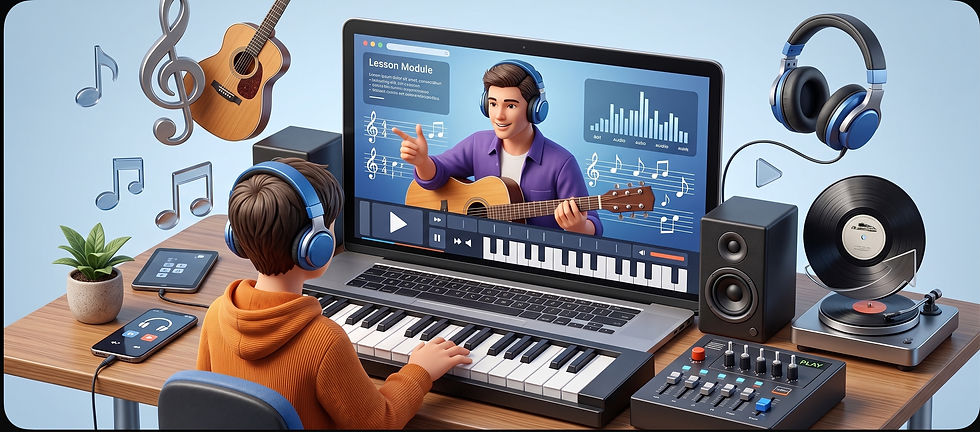
A missed note, an unstable vocal transition, or a tense piano wrist can turn into an ingrained habit long before a student notices it. Virtual learning for music changes that dynamic when it is built around close observation, immediate correction, and personal momentum.
The goal is not simply to place a traditional music lesson in front of a camera. It is to give every student direct access to expert instruction, clear visual detail, and a structured practice plan that keeps progress moving between sessions.
For serious musicians and first-time learners alike, location should never determine the caliber of instruction available. A student in a rural community, a working adult with limited evening hours, and an aspiring performer preparing for an audition all deserve more than a generic video call. They need a focused learning environment designed around their sound, mechanics, and individual goals.
Why Virtual Learning Works for Music
Music is a physical and acoustic discipline:
Singing depends on physiological coordination, breath pressure, vowel shaping, and vocal tract freedom.
Piano, guitar, bass, drums, and ukulele require precise hand geometry, rhythmic timing, ergonomic posture, and physical relaxation.
Music production demands critical listening, gain staging, and a clear understanding of signal flow inside the DAW.
Effective online instruction must go far beyond casual conversation and distant demonstrations. When lessons utilize high-definition video and uncompressed audio streams, an experienced educator can identify the subtle physical cues that drive real progress: a slight collapse in a knuckle arch, excess tension in the jaw, a rushed syncopation, or the exact moment breath support falters in a phrase. The student sees and hears the correction immediately, then applies it in real time.
The Strength of the Live Feedback Loop
The most effective instructional format is private, one-on-one coaching. Pre-recorded video courses can introduce basic concepts, but they cannot intervene when a vocalist strains on a high pitch, when a guitarist pinches their fretting wrist, or when a pianist needs a fingering adjustment before an error becomes automatic muscle memory.
Progress accelerates through a consistent three-step loop:
Performance: The student sings or plays a specific musical phrase.
Diagnosis: The instructor identifies the underlying mechanical cause of the issue.
Real-Time Recalibration: The student applies the targeted adjustment and feels the difference immediately.
An expert teacher also knows how to pace this process. One session might focus entirely on rhythmic pocket; another may address register transitions, tone quality, or stage confidence. Progress depends on what the individual student needs next, not on a rigid, one-size-fits-all syllabus.
What Premium Virtual Learning Should Include
Not every online lesson is built to the same standard. If the audio is compressed by generic meeting software, or the camera angle hides the student's hands, critical technical details get lost. In music, those details make all the difference.
A professional virtual setup should prioritize:
Multi-Angle Visual Feeds: High-resolution video that clearly captures posture, finger mechanics, stick rebound, jaw position, and articulation.
Studio-Grade Audio Quality: Uncompressed sound that preserves subtle dynamic contrast, overtone balance, and true acoustic resonance.
Interactive Learning Tools: Direct screen markups and digital notation that reinforce music theory, chord voicings, and song arrangements without interrupting lesson flow.
Technology is not a substitute for teaching expertise, but it ensures that great instruction translates without compromise.
Private Coaching vs. Group Instruction
In a group classroom, lessons must move at the average speed of the room. Advanced students end up waiting, while beginners can easily feel overwhelmed.
One-on-one virtual instruction eliminates that compromise by tailoring every minute to the student:
Young Beginners: Build foundational rhythm, pitch awareness, and genuine confidence without rigid pressure.
Adult Learners: Make steady progress without the friction and lost time of a weekly commute.
Advanced Musicians & Performers: Refine repertoire, prepare for high-stakes auditions, and resolve subtle technical bottlenecks that limit speed, range, or endurance.
Progress is not always about moving faster. Often, it means slowing down just enough to replace an inefficient physical habit with a healthy, sustainable technique.
How to Get More From Online Music Lessons
Students do not need a home studio to make excellent gains, but a few choices raise the level of every session. Use headphones when appropriate, place the camera where your teacher can see the relevant technique, and prepare your instrument before the lesson begins. For singers, a quiet space and dependable device positioning make a meaningful difference. For instrumentalists, clear lighting and a stable camera angle are often more useful than expensive equipment.
The most important preparation happens before and after the call. Bring questions, share what felt difficult during practice, and be honest about what did not work. That information gives the teacher a clearer picture of the problem. Afterward, practice the assigned material while the coaching is fresh. Short, consistent sessions usually outperform occasional marathon practice.
There is a trade-off here. Virtual instruction offers exceptional flexibility, but flexibility can become inconsistency if students do not protect their practice time. Treat the lesson as a standing commitment. Put practice into the calendar. Record key assignments if your teacher recommends it. Build a routine that makes music part of the week rather than an activity you return to only when life becomes less busy.
Choose instruction that matches the goal
The best program is not necessarily the one with the most classes or the lowest price. It is the one that gives students the level of feedback, technical precision, and accountability their goals require.
A casual learner may want a clear, encouraging path to playing favorite songs. A developing vocalist may need targeted work with Speech Level Singing principles to create more freedom, range, consistency, and control. A songwriter may need piano or guitar skills that support stronger creative choices. A performer may need disciplined coaching that treats preparation like preparation, not wishful thinking.
Ask whether the instructor has deep subject knowledge, whether the lesson environment makes technical feedback possible, and whether the program can evolve as your skills do. A low-cost introductory lesson can be a smart way to evaluate fit, but the real standard is what happens afterward: Are you hearing change? Are you understanding why? Are you building the tools to perform with greater confidence?
A Better Standard for Music Education
The old assumption was that serious music study required a local teacher, a fixed weekly commute, and whatever quality happened to be available nearby. That model leaves too much to chance. Modern students can expect more: elite instructors, individualized coaching, sharp audiovisual detail, and lessons that fit real schedules without lowering standards.
At Better World Music School, virtual learning is designed as an upgrade in access and precision. Private live instruction, advanced HD virtual classrooms, and highly vetted teachers give students a direct path from first attempts to stronger technique and more capable performance. The experience is built to meet students where they are, then challenge them to move forward.
Your next breakthrough may be a cleaner chord change, a freer high note, a steadier groove, or the confidence to finally share your music. Give that moment the focused instruction and consistent practice it deserves.


Comments