
Virtual Singing Programs That Build Real Technique

A missed note rarely starts with the note itself. It often begins with breath pressure, jaw tension, a vowel that shifts too soon, or a register transition that was never fully coordinated. The best virtual singing programs make those details visible, audible, and actionable in real time - so students do more than sing through songs. They build a voice that performs with consistency.
For beginners, that can mean singing a full phrase without strain for the first time. For experienced singers, it can mean strengthening a high register, improving stylistic control, or preparing demanding audition material with greater confidence. The format is online, but the standard should be serious: private instruction, precise feedback, professional-grade technology, and a training plan built around the singer in the room.
What Virtual Singing Programs Should Actually Deliver
A virtual singing program is not simply a collection of prerecorded exercises or a weekly video call with vague encouragement. Those options may be convenient, but convenience alone does not create vocal progress. Singing is physical, acoustic, and highly individual. Students need a teacher who can hear the small changes that affect tone, range, resonance, pitch, and endurance.
Strong programs center on live one-on-one instruction. That distinction matters because every voice brings different habits, goals, and challenges. One student may need to release excess air in the upper range. Another may need help carrying a stable tone through a register break. A third may have good natural ability but lack the musical phrasing needed to make a song convincing.
In a private lesson, the instructor can identify the actual cause rather than assigning a generic fix. The student then applies an exercise, receives immediate feedback, and repeats it with a clear purpose. That loop - diagnose, adjust, reinforce - is where technical growth happens.
The difference between access and advancement
Online access has made vocal instruction available far beyond a local studio. That is a meaningful upgrade for students who live outside major music markets, travel often, manage demanding work schedules, or want specialized coaching without a commute.
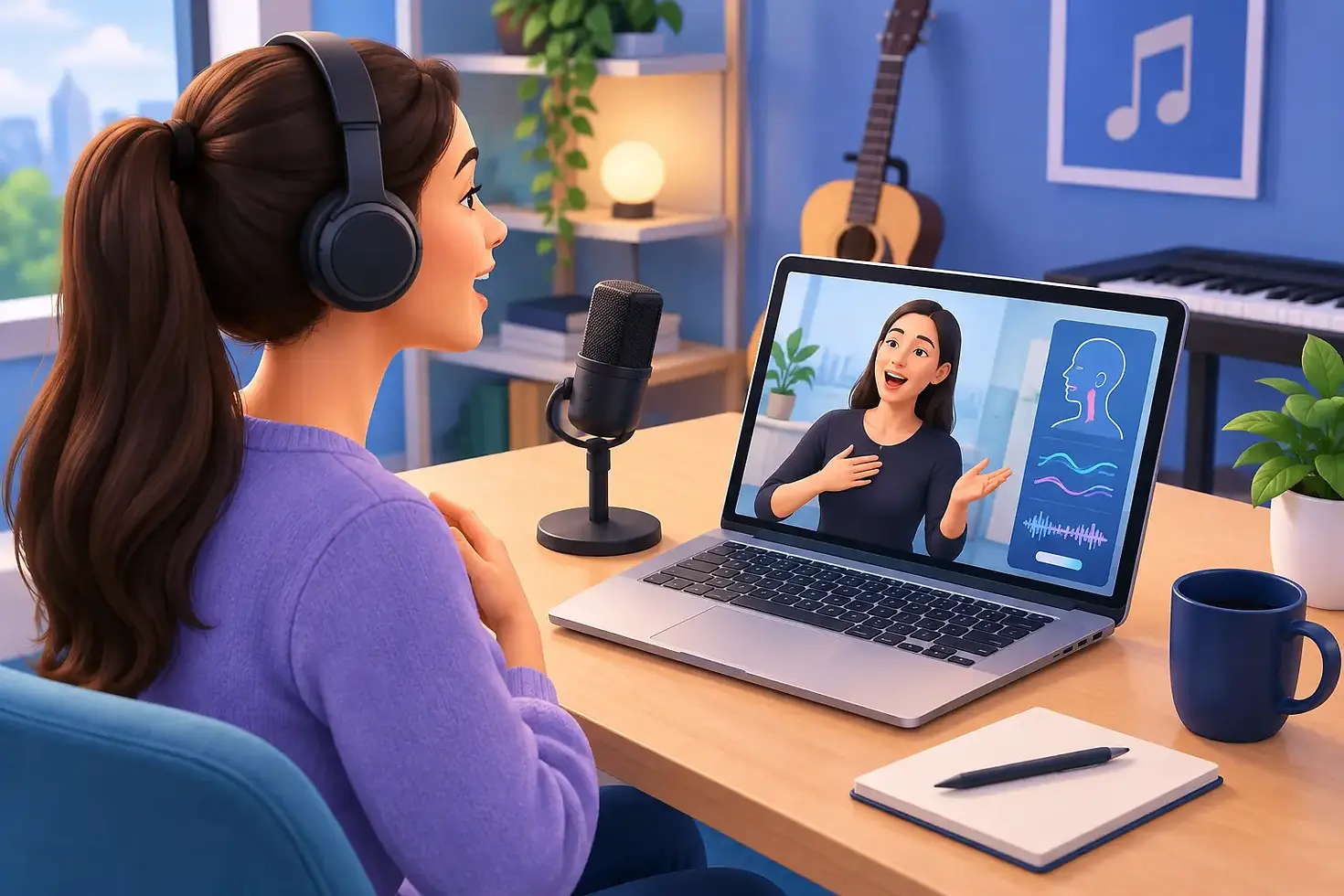
But access only becomes advancement when the learning environment is designed for detail. A basic call can make it difficult to catch subtle changes in vocal color, diction, posture, and mouth shape. A high-definition virtual classroom with studio-grade audio and clear visual tools gives both teacher and student more useful information. The goal is not technology for its own sake. The goal is a better correction, delivered at the moment it can change the sound.
Why One-on-One Virtual Singing Programs Produce Faster Clarity
Group classes can be enjoyable and motivating, particularly for singers who want community. They are not always the fastest route to technical improvement. When a teacher is dividing attention among many voices, feedback must stay broad. Students may leave with good ideas but little certainty about what their own instrument needs next.
Private virtual singing programs create a different level of focus. Every exercise, repertoire choice, and coaching note can connect to the student’s voice and goals. A child learning their first song needs a different lesson than an adult returning to music after decades away. A singer preparing for an audition needs a different structure than someone building confidence for personal enjoyment.
That personalization also helps protect motivation. Progress in singing is not perfectly linear. Some weeks deliver a dramatic breakthrough, while others are about making a new coordination reliable. A skilled instructor can recognize the difference between a temporary rough day and a pattern that needs technical attention. Students stay focused on measurable improvement instead of guessing whether they are practicing correctly.
Feedback must be specific enough to use
“Sing with more confidence” can be encouraging, but it is not a complete coaching instruction. Useful feedback sounds more like: keep the rib cage responsive through the end of the phrase, release the tongue before the vowel changes, or reduce the weight of the lower register as the melody rises.
Specific direction gives the singer something to test immediately. Over time, students develop stronger self-awareness. They learn to recognize when a sound is free, when a note is being pushed, and when a phrase needs a different breath strategy. That is how lessons become lasting skill rather than a temporary boost of enthusiasm.
The Technology Standard Matters More Than Most Singers Expect
The best online vocal instruction does not attempt to imitate a conventional lesson with a laptop on a kitchen table. It improves the parts of the lesson that matter most: sound, visibility, interaction, and continuity.
HD video helps an instructor observe posture, facial tension, jaw movement, and articulation. Studio-grade audio offers more information about pitch accuracy, tone balance, breath noise, and resonance. Interactive visual tools can support rhythm, lyric work, musical structure, and practice assignments without turning the session into a lecture.
There are practical considerations. Internet reliability, headphones, room noise, and device placement affect the experience. Students do not need a professional home studio, but they should take setup seriously. A quiet space, stable connection, and a device positioned at eye level can immediately improve the quality of coaching.
The trade-off is simple: online lessons require a little intention around setup, while in-person lessons require travel, scheduling friction, and limited instructor choice. For many singers, a dedicated virtual setup is the better investment because it expands access to exceptional teachers and supports consistent practice from home.
A Modern Vocal Method Needs More Than Songs
Songs are where singers express themselves, but exercises are where they build the coordination to express themselves well. Effective programs balance both. Technical work develops the voice. Repertoire reveals whether that technique holds up under real musical demands.
At Better World Music School, students work privately with highly vetted instructors in a technology-led lesson environment built for close musical observation. Its voice instruction includes Speech Level Singing, a method designed to help singers coordinate their voice through registers with greater ease, balance, and consistency.
Method matters, but the teacher’s application matters just as much. No single exercise is magic. A productive instructor selects and adjusts exercises based on what is happening in the student’s voice that day, then connects the result to actual songs. That may mean improving a difficult transition in a favorite pop song, building cleaner sustained notes for a musical theater piece, or developing control for more expressive phrasing.
Practice should be designed, not improvised
Students often lose momentum between lessons because their practice plan is too vague. “Practice more” is not a strategy. A better plan defines what to practice, how long to spend on it, what sensations or sounds to listen for, and when to stop before fatigue turns into poor repetition.
For most singers, shorter, focused practice sessions are more valuable than occasional marathon sessions. The right frequency depends on age, vocal goals, current stamina, and the difficulty of the material. A developing singer may need brief daily coordination work, while an advanced performer may follow a more detailed routine around repertoire, conditioning, and performance preparation.
How to Choose a Program Worth Your Time
Before enrolling, ask whether the program offers live private feedback or relies mainly on content libraries. Ask how instructors are selected, whether the lesson platform supports high-quality sound and video, and how the curriculum adapts as your voice changes.
Also consider the instructor relationship. A strong teacher should be demanding without being discouraging. They should explain what they hear, give you a path forward, and maintain standards that make progress visible. Credentials matter, especially when paired with the ability to communicate clearly to a beginner or challenge an advanced singer without wasting time.
A discovery session, vocal assessment, or introductory lesson can reveal a great deal. You should leave knowing more about your current voice than when you arrived. You should also have a clearer sense of what progress could look like over the next several months.
The right virtual program does not ask you to settle for a lesser version of vocal training because it happens online. It gives you the focus, technical precision, and expert partnership to make each practice session count - then carries that work into the moments when you are ready to perform.


Comments