
Online Drum Lessons That Build Real Control

Updated: Sep 6
Struggling with rushing drum fills or uneven ghost notes? Learn how stick fulcrum mechanics, rebound physics, and micro-timing build a rock-solid pocket.
A drummer can have incredible hands on a practice pad, sit behind a full kit, and immediately watch their timing unravel the moment a song kicks into high gear.
The fills rush. The kick drum loses its punch. The left hand feels sluggish on the snare.
When a groove feels stiff or unstable, the instinct is usually to press harder, grip tighter, or drill the same pattern with more force. But drumming isn’t about muscle—it is about physics, leverage, and economy of motion.
The Real Reason Fills Rush: You’re Fighting the Stick
When adrenaline spikes or tempo increases, the human body naturally tightens the forearms and clamps down on the stick with the back fingers.
The moment you squeeze the grip:
You kill the natural rebound of the drumhead.
You force your wrist and arm muscles to lift the stick back up manually for the next stroke.
Your muscles fatigue within two bars, causing your hands to panic and rush into the downbeat to catch up.
To play fast, clean fills that land dead on beat one, you have to let the drumhead do half the work.
Set your fulcrum securely between the pad of your thumb and the second joint of your index or middle finger. Keep your back three fingers lightly wrapped around the stick—not clamping it, but acting as a guide.
When the stick strikes the head, let it bounce back to its starting height like a basketball. If you aren't feeling the vibration of the wood in your hand, you're choking the stroke.
Balancing the Kit: The Invisible "Internal Mix"
One of the biggest differences between an amateur drummer and a seasoned session player is how they balance the volume of their limbs.
In an uncoached rehearsal, drummers frequently bash the hi-hat or ride cymbal at maximum volume while playing weak, tentative snare strokes. This washes out the room in high frequencies and makes the pulse feel muddy.
A professional pocket is built on an intentional dynamic hierarchy:
The Backbeat (Snare): Solid, consistent, and prominent. Every accented strike on beats 2 and 4 should have identical velocity and rimshot placement.
The Foundation (Kick): Punchy and locked with the bassline, delivered with consistent foot-pedal rebound rather than burying the beater into the head.
The Pulse (Cymbals): Kept at a moderate, controlled volume so the cymbals support the track rather than overpowering the vocals or guitars.
The Texture (Ghost Notes): Played from a height of just 1 to 2 inches off the snare head to create subtle rhythmic groove without cluttering the beat.
When you learn to mix your own limbs dynamically, you sound produced and articulate before a sound engineer even touches an EQ.
How to Practice a Fill So It Never Fails on Stage
Running a fill over and over in isolation won't fix transition stumbles. The breakdown almost always happens on the seams—the two beats before the fill starts, and the exact downbeat of the crash after it ends.
Try this three-step isolation routine during your next session:
Loop the Boundary: Play three bars of solid groove, execute your fill on bar four, and land firmly on the crash and kick on beat one of the next measure. Do not stop. Keep the groove moving for another four bars.
Drop the Tempo by 20 BPM: Play the entire transition at a tempo that feels uncomfortably slow. Slow tempos strip away momentum and force you to count the exact sixteenth-note subdivisions instead of guessing the spacing.
Anchor the Left Foot: Keep your hi-hat foot clicking steadily on quarter notes (1, 2, 3, 4) throughout the fill. If your left foot stops moving when your hands leave the snare to move around the toms, your internal clock isn't anchoring the rhythm yet.
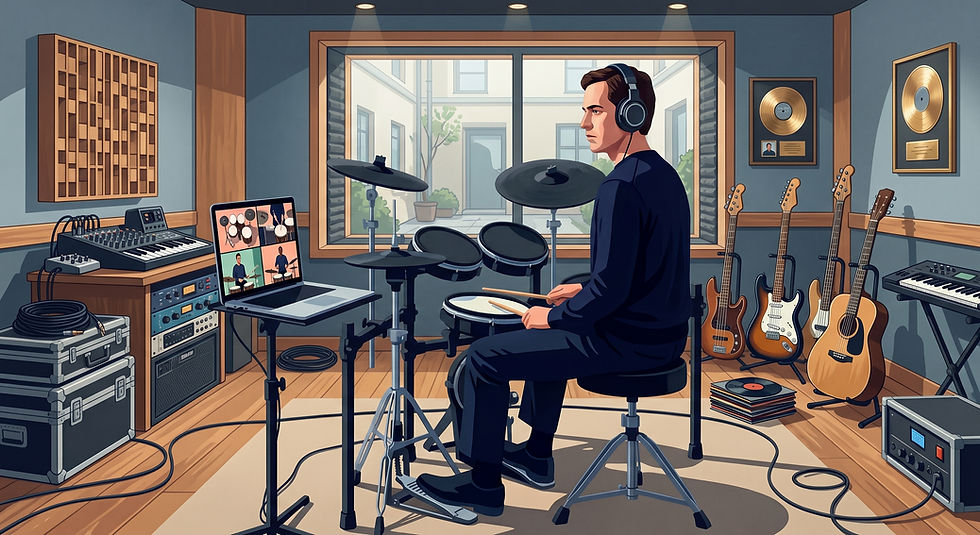
Mastering these micro-coordinations requires real-time diagnostic feedback. During our one-on-one live online drum lessons, instructors use multi-angle HD cameras and studio-grade audio feeds to inspect pedal technique, wrist fulcrums, and timing alignment on your own kit at home.
The drummers who get called back for gigs aren't the ones who play the flashiest solos. They are the players who lock in the groove, protect the tempo, and make everyone else on stage sound better.


This article about drums is really helpful! I've never thought about how nervousness affects timing. I'm not very good at playing the drums. Speaking of instruments, have you tried playing the drums with Online Virtual Drum Set? It costs nothing; you can practice first and buy a real drum kit once you get the hang of it. It's such a cool tool.