
The Vocal Gym: Why Singing Lessons Are Exactly Like Hitting the Weights

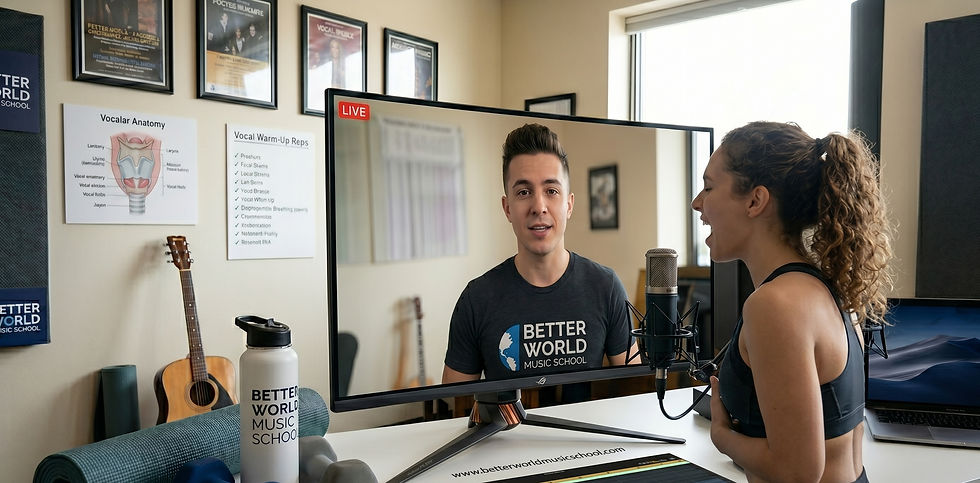
We’ve all been there: you watch an incredible singer effortlessly hit a soaring high note,
and it looks like magic. It feels like they were just born with a supernatural gift.
But here’s the truth that professional singers know: your voice is an instrument made of muscles.
When you look at vocal training through that lens, the whole process changes. Singing lessons aren't just about learning music theory or practicing songs—they are exactly like going to the gym. If you want to build a powerful, resonant, and healthy voice, you have to treat your vocal cords like a set of muscles that need conditioning.
Here is how training your voice perfectly mirrors hitting the gym, and why consistency is your absolute secret weapon.
1. You Are Building Muscle Memory, Not Just "Learning"
When you go to the gym and learn how to do a proper deadlift, your brain is figuring out how to coordinate your glutes, hamstrings, and core so you don't hurt your back. The first few times, it feels awkward. You have to consciously think about every single movement.
The vocal cords, diaphragm, and the tiny muscles in your larynx (voice box) work the exact same way.
When you take voice lessons, your coach is teaching you vocal mechanics. You are training your body to coordinate breath support, placement, and tension release. At first, it requires intense concentration. But over time, through repetitive, targeted exercises—your vocal "sets and reps"—this movement transitions into muscle memory. Eventually, your body just knows how to hit that high note safely, without you having to micromanage it.
2. Progress Requires Ongoing Progressive Overload
You wouldn’t walk into a gym on day one, head straight for the 100-pound dumbbells, and expect to curl them. If you tried, you’d likely injure yourself.
In singing, your vocal range and stamina require the same gradual progression. You can't force your voice to belt out a demanding power ballad if you haven't built the underlying muscular strength and flexibility. Ongoing training allows you to gently push your boundaries. A vocal coach acts as your personal trainer, slowly increasing the difficulty of your exercises, expanding your range note by note, and building up your vocal stamina so you can sing for an hour straight without fatigue.
3. If You Don't Use It, You Lose It
Here is the kicker that trips up a lot of singers: vocal progress isn't permanent.
If you work out hard for six months, build a toned physique, and then completely stop going to the gym for half a year, what happens? Your muscles atrophy. You lose your strength, your endurance drops, and you find yourself struggling with weights that used to be easy.
Your voice behaves identical to this. To keep your improvements, you have to keep training. Consistency is what maintains the muscle tone and coordination required for high-level singing. If you stop practicing and training entirely, your vocal stamina will decrease, and those crystal-clear high notes will start to feel heavy and strained again.
4. Bad Habits Are Like Poor Form—They Creep Back In
Imagine you used to squat with terrible form, rounding your back and hurting your knees. You hire a personal trainer who fixes your form, and suddenly you're lifting pain-free. But if you stop working with that trainer and stop paying close attention, your body naturally wants to path-of-least-resistance its way back into those old, lazy movements.
When you stop vocal training, bad singing habits come back gradually.
The old muscle memory—the jaw tension, the throat gripping, the shallow breathing—is patient. It waits in the wings. Without the regular check-ins of a voice lesson to keep your form pristine, you will slowly and unconsciously slide back into your old, comfortable, but ultimately damaging ways of singing.
The Takeaway: Your voice is a living, muscular instrument. Don't view voice lessons as a quick fix or a finite course to "complete." View them as a lifestyle choice for your artistry—a regular workout routine that keeps your instrument strong, healthy, and ready to perform at its absolute best.
Ready to hit the vocal gym?
To drastically improve your range, build unbreakable muscle memory, and protect your gains for the long haul, expert guidance is everything. Visit www.betterworldmusicschool.com to get the ongoing training and conditioning your voice deserves.


Comments